|
HOME
About US Available
Retired AKK Our Males
Our Females
The Legend
Breed History
Breed Standards
Breeding for
Color
Red AKK
Documents
Contact Us
Questionnaire
Whelping Calendar
| |
The
World of The Alaskan Klee Kai
A Comprehensive Review of the Origin of the Alaskan Klee Kai
By Linda S. Spurlin
In the mid 1970's my husband and I had come down from Alaska to
visit his relatives in Oklahoma. Of their various farm dogs, one of them was a
17 pound gray and white female husky. They called her 'Curious' because she was
a curiosity to them. I thought this little creature was so cute that I asked if
I could take her back to Alaska with us. They seemed quite pleased to be rid of
an extra dog, and thus I acquired my first little husky. It seemed as though
everywhere we went, people flocked around the vehicle to exclaim and marvel
about this little dog. We went into a restaurant and discovered it empty because
the patrons were over at the window looking out at our little dog! I knew I had
to find a way to duplicate this little wonder.
Unbeknownst to me, my brother-in-law and his wife in Fairbanks, Alaska had an
accidental mating between a small dog and an Alaskan Husky, who were the
ancestors of the dog I now had possession of. They too knew they had a good
thing started. However, with all due respect, they had much softer hearts than
I, and their breeding program suffered for it. I, by then, had by trial and
error successfully bred a few more 'curiosities'. Then in the early 1980's my
brother-in-law chose to stop breeding his little dogs and sold them to me with
advice his family would not allow him to follow. His words had been my silent
belief all along, but now I followed them openly and religiously. He said,
"Breed the best, and cull the rest." With my now larger gene pool I began to see
results of this hard core approach quickly and this served as encouragement to
be even stricter with my breeding program.
For those of you who are not familiar with the Alaskan Husky, you should know
that this sled dog is an important part of the history and legend of Alaska.
Their endurance, speed, and heart make them some of the best racing sled dogs in
the world. They are not the fictional husky of the famous Jack London books, and
they are not the beautiful Siberian Huskies which the Russians imported from the
Kamchatka Peninsula in the 18th century to haul their sled loads of fur. Neither
is the Alaskan Husky related to the Malamute whose ancestors were the Eskimo
dogs used by the people of coastal Alaska. Instead, the ancestors of the Alaskan
Husky were a scruffy little Indian dog used by the people of interior Alaska. It
is suspected that the whalebone dog sleds discovered in Savoonga, which
anthropologists "guesstimate" to be nearly 5000 years old, were pulled by the
great ancestors of today's Alaskan Husky. However, this little Indian dog did
not gain much respect in the dog world until the last fifty years or so. During
the first half of the century the Siberian Husky, for the most part, reigned
supreme as leaders in the racing world. Then in the late 1940's, when dog sled
racing began to become a profitable occupation, the tides turned and Alaskan
mushers began in earnest to develop the little village Indian dog into the
Alaskan Husky as we know it today. These are the ancestors of the Alaskan Klee
Kai. The Alaskan Husky is a mixture of the best, and so was the creation of the
Alaskan Klee Kai. I also added a small dose of Siberian Husky, and just the
right amount of smaller dogs of similar conformation for developing my original
stock.
One day a good friend brought her mother to meet me. This woman changed my life
as I knew it. I allowed her to take a few pictures of my dogs to take back to
Colorado with her. Then she began a full scale assault to convince me that the
world needed these dogs and that it should begin with her! I firmly believed
that the gene pool was too small, and that my breeding program was not ready for
the rest of the world. However, with 30 dogs to feed and provide veterinary care
for, I was eventually tempted into selling the first miniature husky to my
friends as a Christmas gift for Eileen Gregory in 1987. Then began the flood of
letters, telephone calls, and newspaper reporters. The paperwork grew. We had to
think up a name for the little huskies. We finally derived the name Klee Kai
from the Eskimo words meaning 'little dog'. My kennel records became so
extensive that Mrs. Gregory offered to store the information on her computer.
Our long distance telephone bills became enormous as we charted information on
each dog. Every puppy from every litter was carefully inspected for
conformation, medical soundness and personality. The puppies were weighed,
measured, and re-evaluated regularly. Fortunately, the majority of buyers
respected our dreams of a genetically sound dog and were extremely helpful by
following our guidelines. They sent pictures, called us to update information,
brought their dogs to visit, and spayed or neutered at our recommendation. The
Wasilla Veterinary Clinic, in Wasilla, Alaska, patiently answered my countless
questions over the years and thus aided us in loading even more information into
our bulging computer program.
And always, always came the tourists. My guest book had signatures, addresses
and requests from nearly every state. And when each person came to visit,
whether or not they realized it, they were being interviewed for the possibility
of being judged fit parents for one of my babies. First and foremost in my heart
was to match the perfect dog with the perfect master. I feel it is important to
include that my idea of the perfect master is more than just one who loves his
or her animal. Owning any animal is a big responsibility. When people have asked
me about the temperament of my dogs, I usually tell them that whether a dog
turns out to be a good dog or a bad dog pretty much depends on the intelligence
of the owner. While it is true that certain breeds can be difficult to live with
if forced to live in an environment not suited to them, it is the responsibility
of the responsible pet owner to channel a dog's energies. If a person does not
have the time, patience, or location to deal with the personality of a
particular animal, then perhaps that person would be better off with either a
different breed of dog or perhaps even a different animal altogether. Just
because a person may love a particular breed does not necessarily mean that it
is suitable for them. Some people may be better off with a gerbil, bird, or even
a goldfish for a pet. No one should own any animal, whether it be a dog, a
horse, or a mouse, unless they are capable of making that animal a respected,
valued and well behaved member of their household. I would encourage every dog
owner to go with their dogs to a good obedience class whether or not they intend
to show that animal in the obedience ring. Any dog that cannot be trained to be
a trust worthy member of society has, in my opinion, a very serious problem,
that most likely begins with the owner. A good obedience instructor can help the
inexperienced deal with these situations. Even the experienced can usually
benefit from new ideas and techniques. I dearly love going to classes under
different instructors and usually come home bursting with new ideas on the same
old things! Follow the old suggestion of "Don't send your children to church.
Take them!" I feel the same about dog classes. Don't send your dog, take him
with you!
I knew eventually, that even though my goal for my little dogs was just to have
them be a beloved little companion dog, that there would be those who would
purchase them who would be interested in showing them. This would require
recognition by a major kennel club. Although my heart was not in it, my files
show that my first contact was with AKC in 1988. Since that time, the Alaskan
Klee Kai has received full recognition by the Federation of International
Canines, the American Rare Breed Association, Canine Rarity Shows and of course
the Alaskan Klee Kai Association of America. Our most recent recognition has
been by the United Kennel Club. The United Kennel Club has agreed that for the
first several years they will only acknowledge Alaskan Klee Kai whose pedigrees
can be traced through the Alaskan Klee Kai Association of America because of our
strict rules regarding each Alaskan Klee Kai being granted breeding privileges
only after being inspected to be sure they are entitled to that privilege. All
those who do not meet with breeding approval must then either be spayed or
neutered. The Alaskan Klee Kai Association of America's Board of Directors has
always respected my concerns to encourage better breeding habits among
responsible owners and thus continue to better the breed. I firmly believed, and
still do, that only the best should be allowed to breed, and my own sales
contract reflected this with a strict spay/neuter clause. However, as the world
of the Alaskan Klee Kai changed, I found I did not bend as easily. I longed for
the days when my friends and I created the Breed Standards over pots and pots of
coffee. What I really wanted was to see a wet nose pressed against an elderly
cheek, instead of someone telling me that I was playing God if I did not allow
their inferior dog to breed.
The time finally came when I re-evaluated my priorities and decided I would
rather stop breeding the Alaskan Klee Kai than compromise my beliefs any more.
In January of 1995 I flew with nine of my remaining Klee Kai to Mrs. Gregory's
kennels in Colorado and left eighteen years of my efforts in her hands along
with a few tears, much advice, and many blessings. Looking back, I must say I
have met a lot of wonderful people along the way, and an equal number of good
dogs. I took many dogs to the airport to go 'Delta Dash' to begin new homes in
other states. I sent dogs coast to coast, from Los Angeles to Maryland, and many
points in between, including the Yukon. People still continue to send me
pictures and updates on their dogs. I am grateful to the people who carry on my
dream as I intended it. By breeding only the best, the Alaskan Klee Kai can
continue to become a breed to be proud of. A breed as genetically sound and free
from defects as possible can only be accomplished through the dedication of
responsible breeders who follow their conscience instead of their hearts or
their wallets.
Although I no longer breed the Alaskan Klee Kai, I still closely monitor their
progress and offer my services in an advisory capacity to the Board of Directors
for the Alaskan Klee Kai Association of America. The Alaskan Klee Kai was first
incorporated in Alaska in 1990 under the name 'Klee Kai of Alaska' which was
later changed to 'Alaskan Klee Kai'. The Parent Club and offices were moved to
Colorado after my retirement. I am proud of the support of the Board of
Directors who, thanks to the wonderful world of e-mail, are in constant contact
from various locations including Alaska, New York and several points in between.
I am pleased that you took the time to read the information on this newly
developed breed. I encourage you to search for more information about the
Alaskan Klee Kai on the world wide web. Although I will not personally endorse
any one specific breeder, all breeders listed here on the AKK Web are members of
the Alaskan Klee Kai Association of America, and therefore will hopefully follow
my original Breed Standards and rules which I wrote for the sole purpose of
encouraging better development of an ideal little companion dog. Please remember
that purchasing an animal is just like any other investment. You should always
research the product you are interested in purchasing. You should inquire as to
guarantees and expect them in writing. You should personally inspect the product
before a decision is reached, and above all else, you should read the contract
first and be sure it includes the things you think you agreed upon before you
sign it. You should also ask to see the parents of the animal you are interested
in. It is very important to see the environment in which your prospective pet
has been raised. Puppies, like children, can be affected their entire lives by
how they were treated at a young age. Any respectable breeder should allow you
to visit their facility, as their schedule allows. They should also understand
the importance of matching the right pup with the right family. I believe if a
breeder does not have time for you, you do not have time for that breeder. You
may also want to consider asking for advice from a veterinarian. These
recommendations may help help ward off potential problems from the very
beginning.
In closing, I would like to offer this pearl of wisdom. May you have the good
fortune of becoming even half as wonderful as your dog already thinks you are.
Thank you for your interest, Linda S. Spurlin, Developer of the
Alaskan Klee Kai
"The World of the Alaskan Klee Kai" is an original work by Linda S. Spurlin
© Copyright 1997, 1998, 1999. This work may not be reproduced in part, or in
it's entirety, on any other world wide web address. A printed copy of this text
may be used for personal use, but it may not be distributed or published in any
way without the expressed written consent of Linda S. Spurlin.
Barbara's Note: Please
note that Not all breeders belong to or support AKKAOA any longer, but it was
the dream of our developer that AKKAOA one day be the parent club. The clubs are
only as good as the members who run them. The best way to make changes is to
join and support and vote.
| |
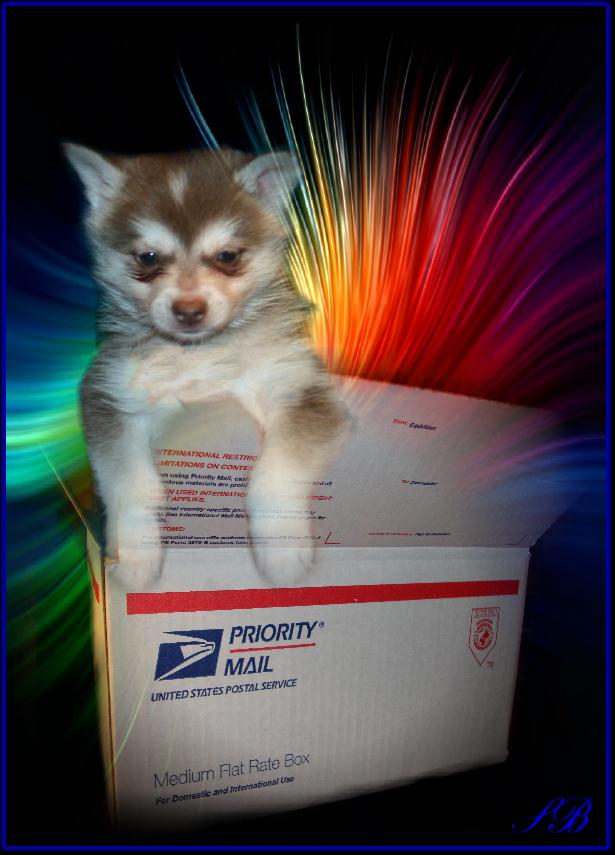
We do transport puppies but not by postal service.
place holder
|